Showing posts with label bookmaking. Show all posts

Monday, November 30, 2020

Calf to Codex

 I don't think I ever posted about this back when it happened, so I figured now would be a good time.

In about 2010 (I think), Master Johannes von Narrenstein had a brilliant idea. We in the SCA, he posited, have all the skills needed to produce a book from start to finish. We have parchment makers and bookbinders, we have calligraphers and painters, we have people who make paints from scratch out of authentic pigments. Why not make a book?

The project took five years, and about seventy-five people, most of whom were poets and composers who provided the content for the book. But they did it, and Codex Mediterraneae is a thing that exists, and I and my child were part of it.

I don't have pictures of all the pages; I was given only the first "gathering" or "quire" of eight pages, and only had to write on about half of them. The very first poem was written about the Middle Kingdom's first king, and set to music in a style that honored the 600th anniversary of the Battle of Agincourt. I took an online course in medieval music notation so that I could transcribe the music to medieval notation and make it "look right" for our book.

The lyrics and notation for the song.

Everything about this book was done as authentically as possible. The pages were parchment made from donated deer hides. The writing was done with black and red ink made from medieval recipes, and a goose quill pen. I was not allowed a pencil to sketch things, I was given a stick of lead! 

Here are as many photos as I could find of the project, with as little rambling commentary as possible.

Testing the inks and alphabet

A mockup of the text and notation of the first page.

Penciled guidelines for the pages

A marble slab to mull pigment, a bottle of gum arabic solution, a glass rod to stir them together, and a shell to put the paint in. I ended up not mulling the red at all.

Painting the guidelines onto the vellum, without a ruler; if you look closely, you can see where I scraped off the leftmost line because I got the spacing incorrect on it.

One page fully lined.

"On the occasion of the 600th anniversary of the Battle of Agincourt, a song of history based upon the Agincourt Carol. Words by Nicolaa de Bracton; tune by Ursula Mortimer."

Lining the page for musical notation is not at all the same as lining it for text!

The page is paperclipped to my guidelines on all sides.

My practice sheet, with the modern notation above and medieval neumes on the bottom.

Copying the musical notes onto the page so that they line up correctly with the words.

Page two of the music. I only included notation for verse one and the refrain; the rest of the lyrics are written as poetry.

The remaining verses.

My favorite part of my assignment: The book curse!
"If anyone take away this book, let him die the death; let him be fried in a pan; let the falling sickness and fever seize him; let him be broken on the wheel, and hanged. Amen." This is a translation of an actual book curse from the Middle Ages.

Preparation to mull pigments for paint.

Assistance with mulling azurite into a fine enough powder to make paint. This is my child, age 10 at the time.

Azurite behaves oddly in that it gets lighter the longer you mull it. The pale yellow-blue to the left is not what we wanted, but the darker blue is almost too gritty to paint with. It definitely added texture to the page, let's put it that way.

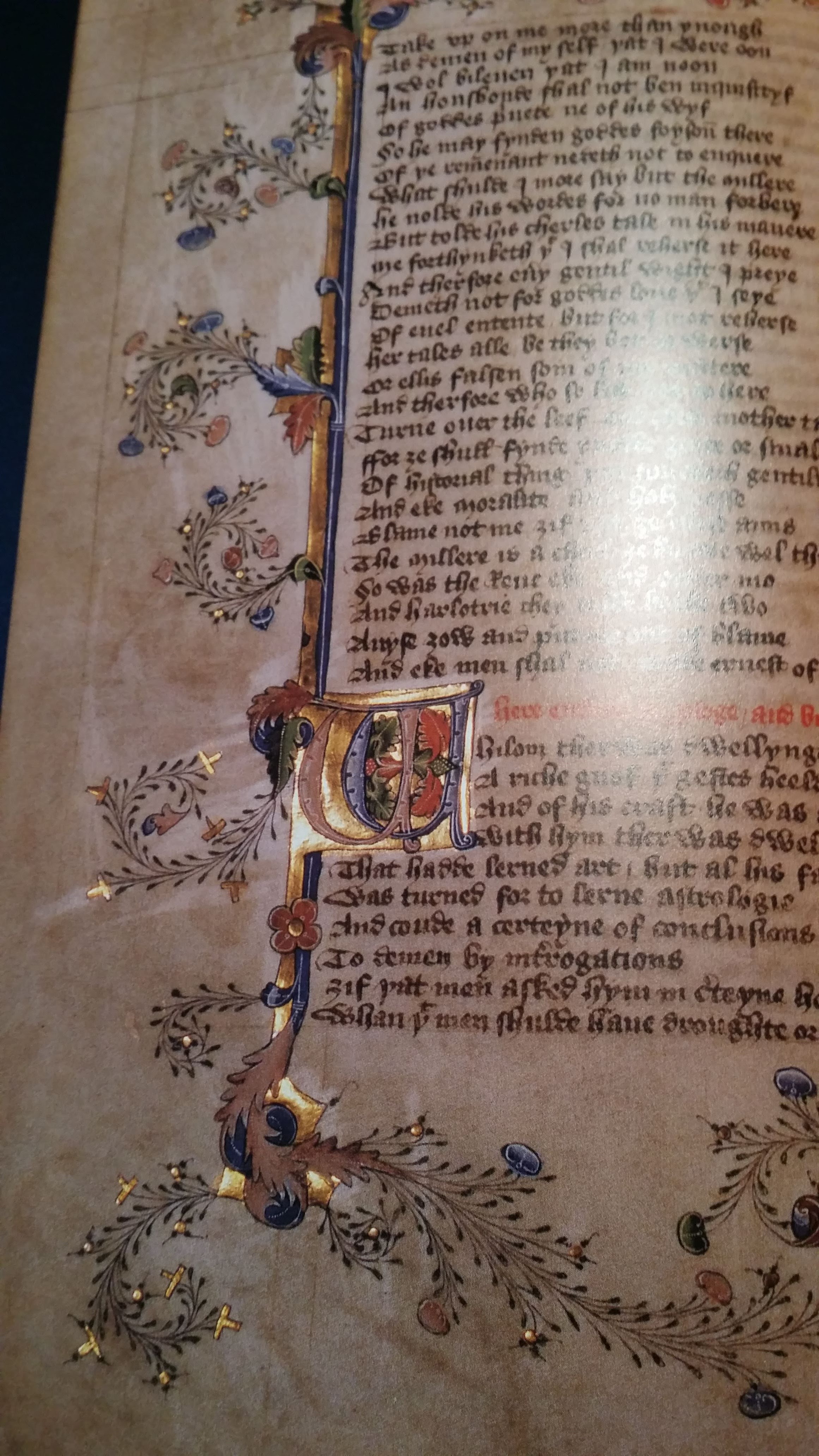
An example page from the 1400s of the illumination style we were to use. We were given several options to play with, but this was the style I preferred.


Sketching a beast modeled after one found on a tapestry dated to the early 1400s.

Preparing the gold leaf; as with the rest of the book, we were not to use modern adhesives. Behind the leaf, you can see a tiny jar of garlic juice.

Gilding upside down, as one does.

Burnishing the gold onto the page so that it will stay.

Sweeping away the excess to reveal the letter underneath.

Painting with garlic juice, in the areas where the gold is intended to stick.

A page of gilded initials.

A fully gilded page, ready to paint.

The gold is in place on this page but the excess has not yet been brushed away.

I always enjoy that before-and-after moment of gilding.

Base colors on the beast; the green is still wet here.

Vine work, leaves, and flowers are added to the golden bar.

The page fully illuminated.

Penwork around the initials on the music page; you can see where the gritty azurite failed to provide fine lines around the red "I".

Another page decorated and ready to go.

Not shown is my child assisting with the painting; the scales were laid out in white and then covered in blue, to give them good contrast with the green. My child painted the blue entirely without help.

Finally the beast was highlighted in shell gold, and delicate vines added around it. In closeup, it may be possible to see the name "Arrantxa" (my SCA name at the time) written inside part of the vine underneath the beast. It actually reads "Arrantxa et Celeste me fecit." Arrantxa and Celeste made me. Celeste was my child's SCA name at the time.

The book itself has traveled to many SCA events to be read and sung from, and has been featured in at least one magazine article. You can read it here.

The Calf to Codex Project remains to this day one of the highlights of my scribal career, and I'm proud to have been even a small part of it.

Wednesday, January 31, 2018

A little bit of ancient history

Okay, not really. But I've spent the past few days going back and organizing my photos from my phone so that it would be easier for me to post here, and going back through old blog posts to see what all I've talked about, and I discovered so many things that I never told you or showed you! Holy goldfish, it's been a lot.

I mean, in 2015, I taught myself how to weave. I'm still pretty terrible at it, but I enjoy it when I can motivate myself to dress the loom. Weaving is like sewing, or like cooking or painting a room: they call it "painting", but 90% of your time is spent preparing to paint, not actually painting. With weaving, most of your time is spent putting the string onto the loom and making sure you don't have any tangles in it, and that the pattern is set into the loom (I'm trying to avoid technical talk here), before you can actually sit down and do any real weaving. But yeah. I learned weaving, and there are no pics or posts or even a tag on this blog for it. For shame!

In 2016, I participated in a project called "Calf to Codex". If you're a knitter, you may have heard the phrase "Sheep to Sweater" or "Sheep to Shawl". It's where someone starts with the raw wool, cards it, spins it into yarn, dyes it, then knits it, start to finish, every step of the process. Calf to Codex was like that. People took donated animal skins (actually mostly deer, but "deer to codex" doesn't have the same ring to it) and turned them into parchment; the organizer collected poems and songs pertinent to the SCA Middle Kingdom's history and origins (because of course this was an SCA project, no one else is quite that insane); we used ink made from a period recipe and goose quills for pens, hand-ground pigments and binders for paint, genuine gold leaf for the gilding and period binders to stick it to the page. Then the pages were gathered and stitched together using linen thread that was spun from flax grown by SCA gardeners; the silk thread used for the decorative stitching at top and bottom was gathered from an SCA silkworm expert who grew the caterpillars herself; the cover was made from hand-planed oak boards covered with leather that was no only hand-tooled, the guy who did it, built his own leather-working tools from wood and brass.

The idea was to show that we have the skill sets and craft know-how within the SCA to set up an industry like this, or at least to recreate it, from start to finish. Between flax growers, chicken farmers (two of the paint binders were egg yolk and egg white which came from period breeds of chickens, because, again, we're insane that way), the silkworm lady, parchment makers, various poets and minstrels, calligraphers, illuminators, the bookbinding team, and the leather-worker, we totaled about 75 people on a project that took five years to complete. It's beautiful, though. A little smelly, because the parchment makers were still perfecting their craft--but the end result should last a few hundred years and is an excellent example of just what we're capable of when we put our minds to it.

My daughter assisted me with some of the illumination. I did calligraphy and illumination, and also took a course on medieval music notation, to write the first song of the book out as music rather than only lyrics. I also got to write a translation of a period book curse: basically, "Don't steal this book OR ELSE".

So that was 2016.

In 2017, I made scrolls, including several to meet our then-king's demand (request) to help get us caught up on a number of overdue awards that had been missed due to a glitch in our award recommendation database. I also got to see one of my close friends from years ago elevated to the highest honor we have for arts, the Order of the Laurel, and got to make her scroll for her. There are, of course, many pictures.

Throughout the past two or three years, I've been doing henna, but recently joined an online "club" for henna artists and discovered that, wow, my skills are not what I thought they were. My confidence in that area is a little shaky, but then, as one of the phenomenal artists said to me, it's not a race. We're not competing with one another. We're all making henna and adding beauty to the world. If I worked 40 hours a week on henna the way a lot of these ladies do, I'd definitely be more skilled than I am presently. As it is, I get about eight hours of practice in, once a month, for five months out of the year. And people still like my work! So instead of being ashamed, I should maybe consider just practicing and using up old henna.

But yeah. I've been busy, I just haven't had much motivation to show it here. There's a blogging app on my phone that works okay, but not great, and getting all those photos organized was definitely an obstacle to posting anything here. However, I hope to post a little at a time over the next few weeks and get caught up to present day, and maybe motivate myself to get something else started again; I'm looking at getting back to my mosaics here in the winter months, or starting a new weaving project. We'll see what happens.

Let me know what you're interested in seeing, and I'll try to post that first!

Friday, April 29, 2011

My Current Hope-To List

Longtime readers will recognize that I've made some cosmetic changes to the blog in the past few days (let me know what you think of those, btw); well, I was doing some stuff behind the scenes and had cause to look at a bunch of posts from about 2008 or so.

It was kinda cool, but also kinda depressing.

Cool to see some of the projects and ideas I'd had floating around – but depressing to see how many of those are still in stasis, and more so to see that the things that were bugging me about life in 2008 are still bugging me today, in 2011.  I still need a job.  I still am having relationship issues.  I still question my abilities as a mother, and my value to society.

Like I said: depressing.  It's as if I'm the project that is currently in some kind of indefinite holding pattern.

However, that's not what I want this post to be about.  I want it to be about all the nifty ideas that I've had floating around, waiting to be acted on, and on all the sweet projects that actually have come to fruition in the past few years.

So, here is my current "hope-to" list.  It's not a to-do list because those are depressing and frustrating; it's a list of stuff I hope to get to because it would be nifty if I could.

  • Hang-gliding; and once upon a time, you could actually take that for PE credit at Indiana University in Bloomington.
  • Marionettes, which have interested me ever since I read Pinocchio when I was about six, and the book had this terrific appendix about them, their history, and how to craft papier-mache heads and the proper way to rig the controls.
  • Mosaics.  I have #3 to repair and then 9 more to build to finish that monster of a project
  • Oil lamps and
  • Silk banners – both of these are for our group campsite at Pennsic, but I've taken a class on oil lamps and they're really really cool.  Cost-effective, safer than tiki and lighter-fluid type things, pretty, and crazy easy to make. The banners would involve learning silk-painting, which I could totally see becoming my Next Crazy Project for a few years, you know?
  • Hand-crafted books.  I already know how to do a specific type of limp-binding, and I've even built one full of calligraphy already as part of a group project to make a "scroll" (see previous posts about the accuracy of that name) back in 2003.  I keep thinking of crafting a pair of books with favorite poems in them, to gift to a couple friends of ours.  Making the book itself only takes about 90 minutes, if you have all the right supplies.  Prepping the pages, doing the text and illustrations and such, takes considerably longer.
  • Decent, regular work in henna bookings.  I could pay my bills with this if I had more consistent business, but that's a big if.  I really enjoy puttin' the pretty on people, though.  Also, that's not really a "project" like the other things on this list.

See, that's my problem with lists:  I start out with "want-to" and start putting in "should" and "need to".  For instance, right now I need to get a job and should start looking.  The house needs de-cluttering, organizing and cleaning.  I should be downstairs getting a load of dishes going.  Blah, blah, bleah, blah.

Anyway.  Watch this space; I hope to get more calligraphy stuff up this evening – but I do have a gig tomorrow that I still need to finish preparing for.

If any of you have ideas for how I could turn this stuff into a regular job, I'm all ears!

Tuesday, July 8, 2008

This, that, and the other

The Mosey Down Main Street was roughly two weeks ago now, and I still haven't put up photos. Oh, naughty me. The problem is that I have about a zillion pictures of the clients I worked on through the evening, and I loved just about every design I did. The whole atmosphere was terrific. I had a blast, and made double the money I've earned at any prior gig. I figured I'd have to wrap up once things got dark, but it turns out I was perfectly placed to take advantage of the light from the storefront behind me, and the streetlight across the way. The event ran till midnight, and I finally decided I was done around 11pm.

***

My family and I spent the holiday weekend with my parents, along with my brother and his family, getting ourselves drenched, waterlogged, bruised (I whacked my elbow HARD exiting one of the water slides), and thoroughly exhausted playing around at Splash Universe up in Shipshewana. Bigtime Amish community, world-famous flea market... and a water park. *shrug* Okay.

One unexpected highlight of the weekend was when my mother mentioned that the books she had ordered for my birthday present had finally come in, after being on backorder for three weeks. I had forgotten all about the backorder, so receiving books out of the blue like that was terrific. Even more so, since they were both how-to books for making other books, by Cheryl Moote. The first is titled Simply Bound: Beginnings in Bookbinding, and the second, Sleight of Binding, has more fun stuff, like "books" with hidden pages, pockets, jacob's ladders, and so on.

Of course, I started playing with these as soon as I got home, and of course, got interested first in the origami Chinese Sewing Kit. It's a series of (kinda) simple origami boxes that are stacked and glued in such a way that the whole thing is very compact, but opens to reveal layers upon layers of storage for needles, buttons, etc. Except Cheryl Moote uses it as a nifty book/journal/greeting gift kind of thing; you can hide messages in each of the boxes, pressed flowers, stamps, tiny drawings, whatever. So it turns into a kind of treasure packet.

Most of the things in these books are not really related to origami at all... but between the Chinese Sewing Kit and the meander-books, I've gotten interested, again, in playing with paper. In 8th grade or so, I learned how to fold an origami horse (me, horse-crazy? nahhhh....), and of course the notorious "cootie catcher" fortune teller. Now with the scrapbooking industry being what it is, gorgeous paper is everywhere, and there is quite a lot of info out there for "scrappers" to make origami additions to their pages, along with popup engineering and who knows what else. I'm heroically resisting getting into scrapbooking - like I need something else to spend money on - but the origami and the pop-up stuff fascinates me.

***

I mentioned something called a meander-book. Meanders are booklets made of zig-zag folded paper (aka "accordion folds") that unfold in crazy directions, rather than just in a straight line. Since they go all over the place, they're great for representing a little trip, or a story about traveling, or - this was my inspiration - "cumulative folktales".

It sounds fancy, but you already know what cumulative stories are:

This is the house that Jack built.
This is the rat that ate the malt that lay in the house that Jack built.
This is the cat, that killed the rat, that ate the malt....


Or, here's another one:
On the first day of Christmas, my true love gave to meeee...

Cumulative tales exist all around the world, and they're a lot of fun. I got the idea of creating a meander book and using the text of some cumulative story or other. As you unfold a meander, the pages don't disappear the way they do in regular books, so page two will show you page one as well.

Weeeellll, I made a test meander out of a piece of construction paper, and it has a total of 32 "sheets", which I suppose could turn out to provide 64 discreet pages to work with, depending on how the thing unfolds. Me being me, I got to thinking about what sort of cumulative story would be long enough to fit in a meander like that... and then I ended up making one up myself. "The House That Jack Built" has a total of ten elements in it (Jack, rat, cat, dog, cow, maiden, man, judge/priest, cock/rooster, and farmer). Mine has something like 22.

Yes, I know. You have my permission to just sit back and shake your head at me. I'm doing the same thing myself.

***

One of these days, I'll sit down and finish the red portion of my mosaic, and then it will be ready to cast - and I promise I'll take a picture once it's done. For today, however, it's going to be all about the data entry, and about getting some display henna back on my skin in time for the Farmer's Market tomorrow. You'd be amazed at what four hours of splashing around will do to that top layer of skin...

Cheers!