Showing posts with label teaching. Show all posts

Friday, April 10, 2020

Online calligraphy and illumination class


It's been a bit since I posted. A house fire will do that, disrupt your routine a bit until you can get your feet back under you again.

But! I'm not here to talk about that. I'm here to talk about a thing that is happening now that my feet are mostly back under me again. I've restocked my art supplies, I have a little table space, and with the COVID quarantine, I have an excuse to teach an online class. In a way, if all goes well, this should work even better than an in-person class, since you all will get to watch over my shoulder while I work.

On Saturday, April 18, 2020, starting at 2pm Eastern time (US), I will be hosted on the Facebook page "RUM Community" in a three-hour demonstration of how to lay out an SCA scroll from start to finish. If all goes well, I'll actually manage to mostly finish the scroll in the allotted time frame! (Odds are actually slim, but I'm going to try!)

If you choose to follow along, we'll be creating a piece in this style:


The class will cover layout and margins, how to use a lettering guide, a bit on left-handed calligraphy, and we might go into selecting a good alphabet for your scroll. Then we'll cover this surprisingly quick illumination style from the late 1400s, some recommendations on tools and materials, and finish with the importance of outlining even though it's tedious.

If you want to follow along, you'll need:

  • Paper, any size, preferably heavy paper like "Bristol board" or heavy watercolor paper. I'll be using 11x14 inches, but a lot of scrolls are done in 9x12, or even 8x10, so don't fret too much about that.
  • Pencil
  • Ruler
  • If you own a lettering guide, I can show you how to use it.
  • For the calligraphy, a pen and ink; whatever size nib that is reasonable will be fine. I'll be using a Mitchell 3.5
  • Ideally also a pointy-nib pen like a crow quill or "mapping" pen for outlining stuff later.
  • For the illumination, definitely red, blue, and green paint, probably also white, a little bit of yellow might not be a bad idea, and then something gold and shiny if you have it.
  • A fine small brush, but don't go overboard. A 10/0 is overboard. You'll want something that will let you do all the fill in work as well as all the detailing. A 0 or even a 1 would work well. I'll probably try and get away with a 3 or a 4!
There are tools I still haven't replaced quite yet, so some of what I discuss will not be demonstrated, but in three hours I hope to be able to take you from start to finish on a piece this size.

The class will be hosted on Zoom, and hopefully also Facebook Live assuming the tech behaves. I'm also hoping that my setup will let people see my work and not just the top of my head while I work!

Watch this space for more information about another, shorter class to be held on Wednesday, April 29 at 7pm. That one will just talk about acanthus leaf illumination, and be done on a single Artist Trading Card.

Hope to see people in about a week's time!

Friday, March 15, 2019

New developments

If you've been following the blog recently, you may have gotten used to me updating every couple of days as I work on the "County scroll" that is my latest scribal assignment for the SCA. If that's the case, you've probably also noticed that I haven't updated in a few days. That's because I haven't worked on the scroll since this past weekend... and that is because I got sidetracked by another project that I'm getting more and more excited about.

The Art Museum of Greater Lafayette offers classes to the wider community, and as of yesterday, I've submitted a proposal to present a once-a-month, single-session, three-hour workshop on basic calligraphy and illumination. Their summer session starts in May, and if there's enough demand, I'll be presenting the workshop in May, June, July, and August. I've spent the past week preparing that workshop (instead of gilding), and an additional course which I may teach in the fall, if there is enough demand.

The workshop itself is pretty straightforward; participants will learn the basics of calligraphy and one alphabet, select a quotation they like (I'll be supplying quotes from Walt Whitman, but they can choose anything they want), and write that on a bookmark. Then they'll paint and decorate the first initial of the quote, for an introduction to illumination. The class will be open to anyone ages 13 and up, with a minimum class size of three and a max of ten, so that I can be sure I'm able to devote my attention to everyone who needs it.

Here's an example of the alphabet, and the illumination style we'll be looking at:


And don't worry, we will be using gold paint instead of actual gilding supplies, and high-quality calligraphy markers rather than dip pens or quills. This is an introductory workshop, after all! No grades, no pressure, just hopefully a good time and a little bit of learning.

I'm not a professional, certified teacher; I didn't go to college for an education degree. But I do at least know enough about this topic, and have enough experience with public speaking and demonstrating in multiple disciplines, that I should be able to keep the workshop engaging and accessible for everyone.

I know at least one person who has promised to sign up, which is also exciting! Here's hoping I get more. 

As for the county scroll, I'll be back to that this weekend, no worries. 

Cheers! 

Monday, January 23, 2017

Finishing touches

I actually handed off the finished scroll this weekend! Here's what I did after the water was cleaned up.

All the work I'd put in on diapering was actually just base coat, believe it or not, and it was necessary to finish it with detail work in white.


Step one. Add a curvy square shape inside each colored square. I've heard these called "pillow shapes".

Step two. Insert a little loop on each side of the pillow, so it looks like you drew pointy leaves.


And step three, insert a little flick of the brush to look like a vein in each leaf.


You'll do this in white on the blue squares and yellow on green. White on green was rarely done, because the usual pigments used would react with one another chemically and turn black.

The images above should show that the red squares are simply "chained together" with connecting diagonal lines. This was a common motif but by no means the only one. Diapering was really popular throughout the Middle Ages and there were probably hundreds if not thousands of different styles used.

The images should also show some of the white work done in the borders of the miniatures.

I also did a little white highlighting of the vines, but by this point I was getting pretty tired of painting, and I didn't take any pics of that. I completely skipped outlining the vines because I was feeling really lazy by that point.

What else did I do, let's see... I outlined capitals and initials, but I think I already showed you that. Here's a before-and-after version of the initial D.


The lighting probably isn't the best to show it off, but the outline really wakes up the entire letter against the paper.

One last image: the finished piece.


The recipient should get it in their hands within a week or so. They've already seen pictures and are very happy with the work and already talking about how to repay me. I tried to discourage them, but they weren't having it. Making scrolls is my hobby just as fighting is theirs; I don't do it to get a reward, I do it because it is rewarding in and of itself. Still, if someone really wants to say "thank you", I've learned that it's not really my place to deny them that... within reason.

And that's the scroll! I'll be settling back down to regular assignments for now, and getting back to writing and editing now that this big project is off my plate. As always, I learned a lot to carry with me into the next project whenever it comes along.

posted from Bloggeroid

Friday, January 20, 2017

Montessori demo

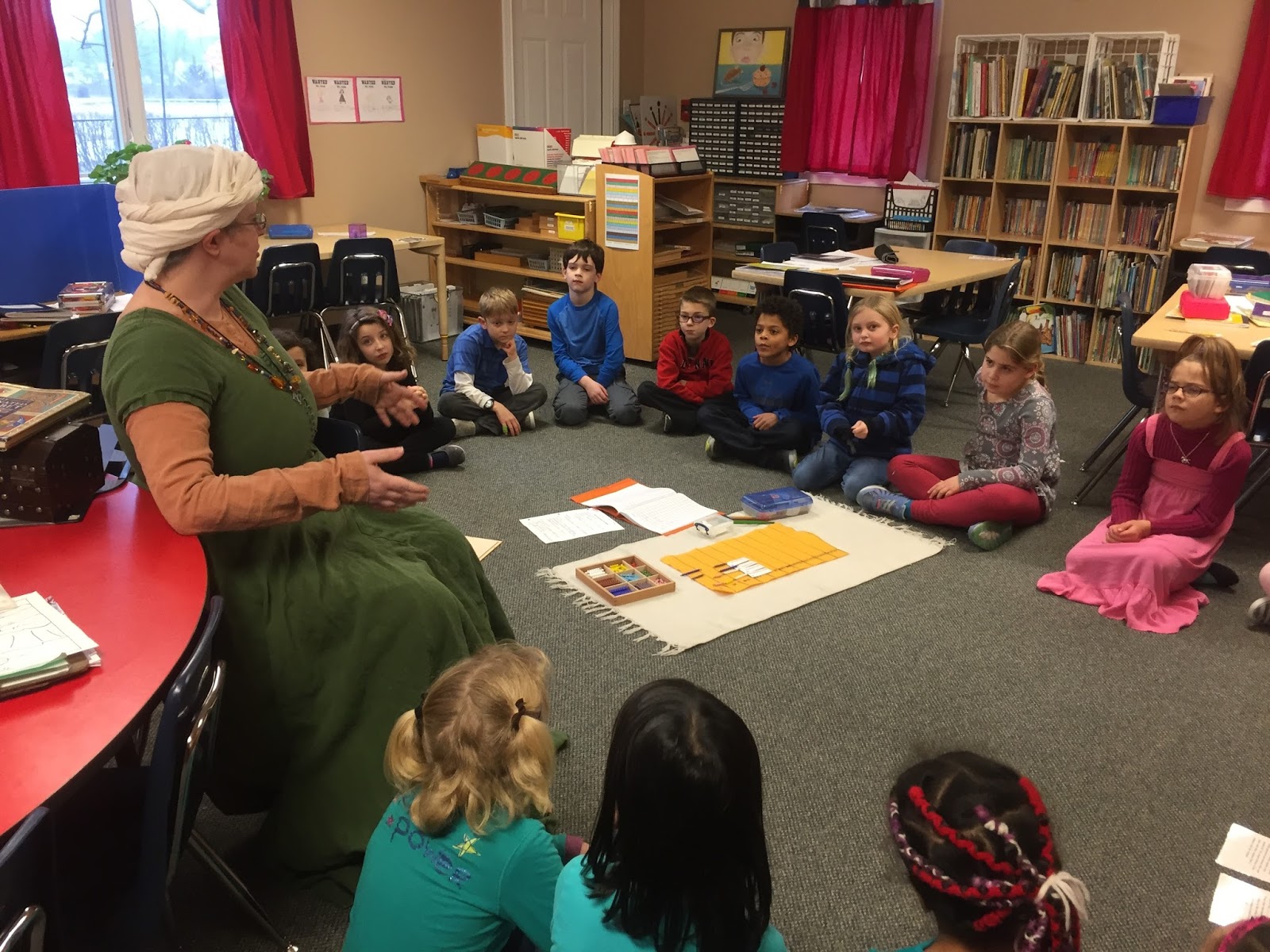
On Wednesday I went to the Montessori School of Greater Lafayette at the request of teacher Emily Frazier to discuss life in the Middle Ages with her mixed class of 1st- through 3rd-graders. I didn't have much of a talk prepared, figuring that the kids would end up leading the topic wherever it wanted to go whether I had a speech planned or not. I planned to talk a little about how books were made ("imagine having to copy out your own school book instead of just buying one or having one at the school"), and then a little about calligraphy and illumination in general. I mean, they're fairly young kids, getting too deep just wasn't going to work.

Letting them lead the discussion was definitely the way to go, once they got warmed up.

Favorite question: "Are you a real life pirate?"

I passed around some of my art supplies, and they thought it was cool that I kept my paint in seashells, and also that I could paint with dirt. (Yellow ochre, burnt umber, and a number of other colors are derived from clay or stone.)

Of course, they also thought it was cool that I knew real blacksmiths, and I discovered that way too many of these kids own their own bows and arrows.


I also had photocopies from my portfolio to pass around for the kids to look at.


Eventually the class split in half, with one group going to Spanish and the other staying with me. I wrote each kid's name in a different alphabet that I could remember, and illuminated a single capital for each group. We did an H for me, and an E for their teacher, Miss Emily. The kids thought it was really cool that I could paint with such small brushes, and write with quills. I was asked if this ink was homemade (because I'd told them that I had made my own ink in the past), and they seemed a smidge disappointed that it wasn't.

Illuminated capitals with some simple white work.

The teachers wrote later to tell me that the kids loved the demo, and that the other teachers at the school were really jealous, which I guess is a good thing when you're a teacher? I dunno. I've also been told that they contacted our SCA group to see about arranging a larger demo in March or April. The theme at that point will be "defense", and I strongly suspect that we would end up besieged by little kids with marshmallow catapults at that point.

So that was what I did with my Wednesday afternoon. It was a blast, and I'd love to do it again sometime. Thanks again to Miss Emily, Miss Marilyn, and all the kids for a great time.

Wednesday, January 18, 2017

Fixing water

I won't actually be able to work on the scroll today very much, because I'll be preparing to speak at the local Montessori school as part of their medieval unit, and I'll need to bring some of my supplies with me. But a couple days ago, I made enough progress that I could have blogged twice and didn't, so now I get to catch you up with where I actually am.

I had a problem with the water in my battle scene. The paint didn't go on very solidly and gave a really patchy look, which I was willing to ignore except it was pointed out to me that it didn't actually look very period. It just looked messy.


So the first thing I needed to do was add another coat of the blue, and try to make it more opaque. 


It turns out that a lot of period manuscripts didn't even bother with "blue" water, making it more blue-gray, or even gray-green or brown. As Mark Calderwood put it in our conversation, "Should be a slate/miserable cold english waterway i'm not getting in that are you mad colour."  So after I got the blue down, I needed to add a thinner wash of grayish-blue to try and fix it.

A note about me: I tend to do art very cautiously. It's one reason all these fussy details come out so well for me, but it also means that when it comes to, say, mixing colors, I'll be convinced I've gone way too dark when in fact I'm only halfway there. So these pictures aren't actually gray enough, but they're still better than they were to start with.


Finally, the "waves" were added to make it look recognizably like water. Bear in mind that the effect here wasn't to be lifelike so much as symbolic and, again, recognizable. A five-year-old could look at this blue wavy stuff and go, "That's water!" and that was the effect I was going for.


If I want, I could probably go back in and add even more gray to the blue bits that are still showing, to try and dull the water even more. We don't want it to detract from the main focus of the scene, which is all these bloodthirsty people trying to kill each other, so if it's too bright, I may still go back and do that.

Once the water was taken care of, it was time to add detail to the right side panel, same as I'd done on the left yesterday. Time for highlights and shading!


So now here we are with the finished figures; I'm pretty sure I used the wrong color to shade the standing figure, but he doesn't look too horrible so I'm not going to fret about it. There wouldn't really be a good way to fix him anyway, and I've come too far to turn back now, so he's stuck the way he is.

One final step, which I have not yet repeated on the left. It's subtle, so I don't know if this picture will show it or not, but when you get ready to add detail to the diapering in the background, the first thing you do is outline every square with dark paint or ink. Every square. This is almost as tedious as it sounds.

Looking at it from a distance, it's hard to see that I've done anything, and yet if you study the two panels side by side right now, the one on the right has just a slightly more crisp look to it, in my opinion.


Tomorrow, I'll be ready for outlining the diapering on the left-side panel as well, and then it will be on to white-work detailing, whether I like it or not. It's another of those stages that is essential, but slow and fussy all the same, so you kind of wish you didn't have to do it even as you're marveling at how cool it looks when it's done.

Cheers, everyone, and thanks for following along.

Monday, May 9, 2011

Because fire is pretty

I've been working on oil lamps lately; our group camp is looking to upgrade to something slightly more authentic to the Middle Ages than tiki torches, and oil lamps were ubiquitous throughout our period of study, more prevalent even than candles.  I took a class on them last year (man, I love Pennsic), and using that as a starting point I've gone a-hunting for period-looking substitutes for ancient oil lamps, vendors, and all that good stuff.

It turns out that a lot of candle holders make great lamps.  In fact, it's believed that candle holders were originally a kind of logical extension of the oil lamp, so that when they were first made they were basically just modified versions of an already existing form.  Certainly they carry a lot of similarities to this day.  Observe:


Both of these are sold as candle holders at our local Pier One Imports.
Solid background provided courtesy of my husband (have you ever been in a Pier One?)
Note cameo appearance by swiftly-moving daughter.

I don't have them scanned just now, but these bear a crazily strong resemblance to surviving medieval artifacts, as well as lamps as depicted in countless medieval manuscripts, paintings, and the like.  If anything, these are a little plain in comparison to these accurate reproductions of period lamps.

Here is another candle-holder that I have at home already. My so-called "votive holders" have already been filled partway with water and topped off with some leftover sesame oil (from a delightful evening learning about Filipino cooking, but that's another story) and three homemade float wicks.


The box it came in calls this a three-tiered votive holder.  The stand is a little questionable, but those glass cups bear a very strong resemblance to surviving oil-lamp artifacts. In fact, they're almost replicas themselves, although the makers may not have realized that.

A (blurry) closeup showing the float wick

The float for this type of wick is often made of something flammable like cork.  To protect it from the flame, you stack it with a little disk of metal (brass is period, the aluminum foil shown here isn't but I was experimenting), then punch a hole through both and thread your wick through.  Any natural fiber will do, although I'm told wool doesn't burn well at all.  My class instructor explained that for availability and cost, nothing beats an old-fashioned mop head!  And in fact all three of these wicks were made from one strand of mop, which was originally made of four smaller strands of cotton twisted together.  I just untwisted and separated the strands to get the right size I needed.

...And now you know a cute piece of trivia about mop heads.

Of course, the real question is, how does it look?  The answer:

Pretty darn sweet.

And, although it's anticlimactic, I'll go ahead and include this image just so you can get a better look at everything...
Yep, still pretty darn sweet, even with the camera flash.

Just like other fuel-burning lamps, these wicks are adjustable to keep the smoke to a minimum.  Unlike other fuel-burning lamps, this one smells nice and accidentally ingesting the oil won't kill you.  (See above re: Filipino cooking.  This stuff is slightly darker because it's the used oil, not the extra left in the bottle that we didn't cook with!)

These lamps are safer in another way, too:  vegetable oils in general are also much harder to ignite than petroleum-based fuels, so much so that if this lamp were to tip over, the oil still in the reservoir could possibly extinguish the flame rather than catching fire.  The added water in the bottom helps with that as well, in addition to conserving oil, allowing more light to shine through the reservoir, and acting as a heat shield to protect the reservoir itself.  See, if this lamp were filled only with oil, then as the oil was consumed, the flame would get closer and closer to the bottom of the vessel; the glass would get too hot to handle, and could crack.  (To say nothing of what would happen to the lamps that were made of wood!)  A number of medieval illustrations show people carrying around larger versions of this lamp shape in their bare hands, not unlike the way we carry around a glass of wine or a large snifter-type glass; that would be impossible without filling the bottom with water.

And oh look, I've rambled on yet again and it's 11pm yet again, and I'm really bloody tired, yet again.  Time to go downstairs and blow out the flames, which have been burning steadily for at least the past 3 hours.  Fire is pretty; it's even prettier when you can make it safe.

Special thanks to Bedwyr Danwyn for his research and presentation of much of this material during Pennsic University.

Thursday, April 28, 2011

Big Awesome Calligraphy, Part 1

So, I made this amazing scroll* a couple weeks back, and ever since I've been promising I'd upload pictures of the entire project from start to finished, and have repeatedly, y'know, not done that.  I realized part of the reason I've been delaying is that, just as the process itself was involved, time-consuming, and quite a bit of work, posting the story of that entire process is likewise going to take a lot of time.  And I simply haven't had both the time and the energy in one place all at once in order to be able to do it.

However.  I do have time to put part of it up.  So here we go.

*Note to all those people who don't actually participate in the SCA.  A "scroll" is our term for an award certificate, given to one of our members for any number of reasons but usually related to skill in fighting, skill in the arts, or service on any scale.  It's worded like a Victorian/modern romanticized version of medieval legalese or proclamations, decorated to look like a page from a medieval manuscript - usually something pretty like a bestiary, Book of Hours, psalter or Bible - and referred to as a scroll.   Yes, we know none of those pieces fit together to make anything truly authentic to the time period.  We kinda don't care.

In this case, the recipient was known to have an Irish persona - in other words, when he dresses up in funny clothes on the weekends, he pretends to be someone who might plausibly have lived in medieval Ireland - but his chosen time period turned out to be a few centuries after the creation of the Book of Kells, Lindisfarne Gospels, or any other obvious choice for gorgeous Irish manuscript art.  Hunting around for stuff in his century led me to a 12th century artifact called the Cross of Cong.  This is a processional cross - the kind you put on the end of a long staff and march through the streets on holy days, then remove to use on the altar - and was also at one time a reliquary.  A piece of polished, clear quartz on the cross's body once sheltered a little sliver of wood believed to have come from the True Cross.  The thing is absolutely gorgeous:

Public domain image imported from Wikipedia

And, as has been established before, I can get absolutely carried away by things that are absolutely gorgeous, so this became the inspiration and basis of the entire piece.  It was made of gold, silver, copper, bronze, and something called niello, which is a metal alloy that comes out black, all laid over oak.  In addition to the piece of crystal I mentioned above, it had colored glass and and semiprecious stones, enamel work, and probably more that has since been lost or damaged.  The thing is 900 year old, it's going to have a little wear and tear, okay?

Manuscript pages very rarely used silver leaf, and so far as I know they never utilized copper.  Speaking personally, I've only used more than one metal twice, the first time being gold and "silver" (actually 12K white gold, likely a 50/50 blend with silver) and the second time being gold and copper.

I have to confess something to you here, whether you are actually surprised or not: part of my joy in making these pieces comes from knowing that I'm doing something a little crazy.  Having people look at me and suggest I need professional help (or to quote one friend, "OCD much?") is, in fact, a source of delight when I'm sinking my teeth into a new project.  What can I say? Cackling madly is fun.

Annnyway...

Further research gave me some insights into which alphabet style (aka script or ductus) to use; even though I've described our scrolls as being built out of a handful of disparate elements, I personally do like to at least try and match the time period of the words to the time period of the decoration.  So I test-drove a few. 
Testing different alphabets, line spacing, letter sizes, and so on

The script being used most often at that time was actually meant to be a quick-and-dirty system, built for speed rather than elegance, but the scribes also had a more formal style, and would "hybridize" the two pretty much at will, so I got to have some fun creating a hybrid that I liked and was readable be people besides me.

Believe it or not, though, the alphabet studies didn't come first.  First was a round of concept sketches for the entire piece, getting an idea for what layout would look best, figuring out how much space the text would be allowed to fill, where my margins would be, and all the other kinds of decisions that underlay a piece but are generally invisible once it is finished.

I have those.  I didn't scan them.  You'll be able to see the final layout yourself once I upload the thing.  If you like, I can give you the measurements and other such, but I have this feeling I'd only be boring you.  I mean, do you really care that I originally hoped to have the measurements of the paper match the measurements - or at least proportions - of the Cross of Cong?  Does exposing that much of my geekery leave you concerned, or entertained?

Yeah.

And now it's 11:24 and we're done with part 1 because I don't want to stay up till 2am going further with it.  And I would.  I know me.

Wednesday, April 27, 2011

Music! Henna! Links!

So, as part of my involvement in the SCA (Society for Creative Anachronism), I have finally gotten back to singing in our local chapter's choir, the Rivenstar Madrigali.  Recently one of our members recorded one of our rehearsals.  As my friend and fellow soprano Katya said, "Not bad for a take-all-comers casual choir," and I agree.

http://www.youtube.com/watch?v=GhXwGMH6giU

If you want to play Spot The Blogger, I'm the only one there who didn't have this piece memorized, as the others had been rehearsing it for months and I only rejoined in January.

As a self-professed choir snob, it's been hard for me sometimes to just let go of the expectations about what I think we "should" be doing (based on years in college-level choirs with conductor/instructors who demanded a very, very high level of focus, discipline, attention to detail, skill, and all the rest that goes with taking choir for a grade), and allow myself to enjoy all the things that we are doing.  We're singing, and we're enjoying the sound, and you know what?  That's something to be grateful for all by itself.

**

Next Wednesday kicks off my fourth season with the Sagamore West Farmer's Market!  Today I finally got my contract and booth fee delivered to the right people!  They were already full!  They were only merciful about letting me in because I'd achieved "permanent" status!  I'm using up my lifetime quota of exclamation points with this paragraph!  Woo-hoo!

**

Next Wednesday, a couple hours before the market kicks off, I'll be at Sunspot Market giving a talk as part of Sunspot's "Food For Thought" program.  Basically they serve lunch and invite a speaker to come be all educational and stuff, and I get to talk a little about the history and culture of henna, then give people free samples before dashing up the street to set up my booth.  They have a little flier that they put up for each month's speakers, and when I stopped in to buy supplies today, I saw that they were gracious enough to give me a really nice blurb.  Felt nice to see, you know?

If you're local, I'd love to see you there, and if you can't make it, well, the market really is only a few blocks away.

Cheers!

PS - Ladysmith Black Mambazo. That is all.

Saturday, April 9, 2011

Gesso

Today, thanks to the generosity of Beloved Husband, I got something close to eight uninterrupted hours on the Thing. There was gesso. Possibly tonight there will be gold. Tomorrow will be more gesso, followed by white gold, and even more gesso followed by copper. And then there's the flat gilding to do. Muahahahaa.

What is gesso?  Super-thick paint.  The medieval recipe called for slaked plaster among other things (mix a batch of plaster.  Stir it too long and you will mess up the chemical reaction, and it will never set.  This is slaked plaster).  Modern people use gesso to help prepare canvases for oil painting, I think.  We medievalist wingnuts use gesso to create a raised surface, a little 3D action on our work, and then we put gold leaf on it.  The gold gets all flickery and flashy as the light hits it from different angles.

It's crazy time-consuming to do, and can get discouraging when you realize you've spent all this time on this one step and still have more to do.  But the gold takes care of all that.  Laying gold is not like painting at all.  Gold is instant gratification - lay it on the sticky gesso or whatever else you're using, hit it with a dry paintbrush to sweep away the bits that you aren't planning to keep, and poof! Instant shiny.

The only thing is, gold sticks to itself.  This is a blessing most of the time, because it lets you build up the layers of gold to get an almost velvety, luxuriant result (and yes, up close you can tell the difference between one layer of thin shiny metal and several layers of thin shiny metal.  You wouldn't think it would matter, but it does).  However, if you're working with more than one color of gold - say, 18K "white" gold as well as 23K regular gold - you can end up with your second color trying to adhere to and cover up the areas you did with your first color.

What this means for me is that I'm taking precautions by laying the gesso in stages, so the gold won't have any option but to go where I want for this first stage.  For the second color, I'll lay gesso down in the new areas, and then do something with the new color that we fancy artist types like to call aiming carefully.  As in, hit the target and don't miss.


Luckily, the third stage will be copper.  I've never worked with more than two metals before, but copper is nice because it doesn't stick to itself, nor to the gold.  This means that, a: I can put it on last and not have to worry about ruining my previous efforts, and b: the leaf itself starts out thicker (since you can't build on it with more layers) and therefore much, much sturdier. Just in my experience with my stuff, copper leaf is to gold leaf what aluminum foil is to copper leaf.
 
No, I won't be adding aluminum to this page.  Yes, dammit, I did just get the idea to try it sometime.
 
Here endeth the lesson.  I'm just so edjimacational, you know?
 
Tomorrow, lots and lots of shinies!

Tuesday, December 8, 2009

My newest project – Internet Marketing

Well, kind of, anyway.

If you found a link to this post somewhere (and if you did, PLEASE tell me where) and followed it hoping I could tell you How I Made 17 Bajillion Dollars Online In Just One Week And You Can Too No Really, then I'm sorry.  I don't really make any money online as far as I know.  I do henna for people at parties and such, and have a great time doing it.  My phone number is over there in the sidebar, which is pretty much the entirety of my "online" marketing.  My "offline" marketing being pretty much my business cards, and word of mouth.

So, no: not a marketer.  No articles here.  Certainly nothing to buy for $237 197 127 57 only $27.

No, what I've been doing is reading stuff online about how to become an internet marketer, and now that I've gone wallowing in the smelly end, I'm here to pass along my newly attained wisdom – mainly because I wouldn't want anyone I care about to go getting themselves smelly, either.

Gem O'Wisdom #1: Internet Marketing itself isn't actually dirty.

The phrase itself – Internet Marketing – has become associated with people yelling at you to Buy Their Stuff So You Yes YOU Can Become Wealthy.  But look at the words, and you just have "internet" – the online world and all its joys – and "marketing" – selling stuff.

And yes, anybody really can sell things online.  Have you ever run or been to a garage sale?  You don't have to be an entrepreneur to sort through your stuff, put price tags on the stuff you don't want anymore, put an ad in the paper, and open up your front yard to people so they can come shop.

Internet marketing – selling stuff online – is the exact same thing.  There are ways to go about it that anyone can follow.  You can sell potted plants online, and people do.  The one major difference between selling stuff online and selling it in the real world is that there is ONE product that is easier to get online than off.  That one product - the one big thing that you (yes, you) can give people online, that they can't necessarily get from you in the regular world – is your knowledge.

You can put together little articles where you tell people what you know about growing orchids, or knitting baby booties, or grilling the perfect steak, and you can put that out there for people to buy.  Or you can review other people's products and maybe earn a commission for that; or maybe you set up shop as an affiliate, which is simply selling other people's stuff for them and getting a commission from those sales.

See? That's not so hard.

The loud noise you're hearing about Internet Marketing is simply coming from people who are trying to sell you their product – and their product is information in how to go about making money online.

You can't really blame them – but you have to admit that people selling orchids are a lot quieter.

Gem O'Wisdom #2:  Good lord there are a lot of scams out there.

Since the biggest market for selling things online is actually in How To Sell Things Online, it's only natural that a: there's plenty of room for con artists to hide, and b: sooner or later someone will try to make a quick buck by promising you that you can make a quick buck – 'cause who doesn't want to make money without having to sweat over it?

Laws are changing, finally, so the ones that don't will eventually become harder to trip over, but the fact remains that there are a lot of offers out there that are worthless.  A really great place to hit in order to look up potential scams is I've Tried That where, as they say themselves, "we lose money so you don't have to".  They sign up for everything, run through the programs, look for customer support, try to clarify what the heck it is you're supposed to be doing for the various Great Opportunities out there, and then tell you which ones work and which ones don't.  Then they write their reviews with clarity, which I respect, and a sense of humor, which I really really respect.

My personal favorite is the one where you make money by selling products to other people telling them how to make money by selling products to other people telling them how to…. are you noticing a pattern here?  The advice actually sucks, but people pay you for it because they don't have any way to look inside the cover or listen to a sample track, the way you can with books or CDs in any reputable business, online or otherwise.  So you buy the garbage and then the only way to recover your loss is to turn around and try to sell the garbage yourself.  And maybe you do manage to sell some, so it's not a true scam because after all you did make money… but it's not ethical, that's for sure.

Gem O'Wisdom #3: The marketers have largely fallen victim to their own press.

If you ever watch The Daily Show with Jon Stewart, you've probably seen one of the ways he likes to make fun of the major news networks.  For those of you who haven't seen it, it goes like this:

Major news networks try very hard to stand out from one another and convince viewers that they are the most trustworthy source for information.  And then they turn around and all latch onto the exact same sound-bites and catch-phrases… which The Daily Show puts together into a glorious montage where you get to actually see just how thoroughly the news anchors all mimic one another.

Well.

Internet marketers do this too.  If I have to read the word "guru" or see any of the other funky acronyms like SEO, PPC, CPA, or all the rest of the vocabulary, I want to be paid for it.  Seriously.  Send me a nickel every time you make me look at one of these words in your Next Big Thing Of Internet Marketing.

Part of the reason for this is that a great many of them are hooked together in vast networks of "you scratch my back, I'll scratch yours".  Let me 'splain.

Pretend I have a store.  I sell things.  I need customers to buy my things, which means I need customers to come through the door to look at my things.  In the real world I put out signs and welcome you in, show you my things, and hope that my friendliness and quality will convince you to not only buy my things, but to come back later and buy more of my things.

Online, my "store" would be a webpage, blog, or just the blurb over on EBay about the velvet Elvis paintings that I'm trying to get out of the house.  Anybody who surfs the internet could potentially walk through my door and check my things, i.e., visit my website/blog/whatever.  I'm not actually there, since it's likely that people are surfing the web at 3am, so if I'm going to interact with you at ALL, I need your email address so I can talk to you that way.  I'll offer you something free, in exchange for your address, and once I have it, I put you on my mailing list and I send you offers.

Internet marketers worship at the altar of traffic, because visitors mean potential customers, and they do everything they can to build their list of email addresses, under the logic that this means more customers they actually get to talk to.

Unless you're me, in which case you sign up for the free stuff, get the link in your email for the free stuff, download it, and then immediately get the hell off their email lists…

...because if you don't, they will send you offers.  Lots and lots of offers for things that they may or may not have anything to do with.  Offers of free stuff from their sites, offers of pay stuff from their sites, and best of all, offers of free or pay stuff from their "good friend" who just happens to also be an internet marketer.  And if you want to get the free stuff from the good friend, you will also need to sign up to join their list.  Rinse, repeat.

I have a little 5x7 notebook in front of me as I type this.  It has about seven pages of names in it, names of marketers whose lists I signed up for, so as to get their free stuff.  (I admit it, I'm poor, and I'm cheap.) Under each name I wrote down who they're connected to and making offers on behalf of – because once I got up to 300 emails over the course of a weekend, I needed to keep track of whom I was signed up with, whom they were trying to interest me in, and whether or not I had already signed up with those people.

Do you have any idea how many people are "good friends" of the same guy and are offering me the exact same package from, using the exact same wording?  My personal favorite: "I just got off the phone with my good buddy [internet marketer guy], and convinced him to let me offer this to you for free."

Funny, this guy must be really easy to convince when you realize that I got that email from five people, who have ALL just gotten off the phone with him.

Anyway.

The end result of all this is that the internet marketers are largely all offering similar products, with similar vocabulary, and similar assumptions about what is important – namely, traffic, building email lists, and getting noticed in the search engines.

I'm not saying these guys are scammers; in fact I think many of them are probably selling legitimate products that they really  believe in.  I'm only saying that it gets really, really repetitious, and boring, to see the same offers coming to my Inbox from several different lists.  I'm not completely sure these guys are aware themselves of just how intertwined their efforts have become.

Naturally, there are a few exceptions to all this, and if you can find them, they tend to be gems.  (Or scams, but those are getting easier to spot.) The gems are interested in helping you learn how to sell YOUR stuff, not convert you to the worship of traffic.  It's really, really easy to get sidetracked into focusing on all these things that the marketers tell you are important, when for the most part they're only important to the marketers themselves.

Let me put it another way.  If you want to learn how to sell your stuff, you'll make money eventually.  If you want to learn how to make money online, you'll focus on all the methods of selling without necessarily having anything to sell.  The gems will teach you the methods, but will keep the focus on you, and how to help you sell your stuff.

One of them I only just discovered today is a guy named Ian at Conversation Marketing.  His premise is the radical notion that more traffic is not necessarily better traffic, and that dressing up in a yellow jacket and red tie and hollering like Crazy Eddie The Used-Car Salesman may not be the best way for you to actually find a customer who wants to buy your stuff.

***

I've rattled on long enough about this.  If you like, I'll be happy to throw together another post where I talk about all the other things they have in common – like the wording on their sales pages, or why they all think it's necessary to price their stuff with a "7" in it.

Or, I could give you a list of who all is promoting whom; or maybe breakdown some of the basic options you have for trying to promote and sell your stuff.

Or, I could try and convince you to give me a phone call and book me, so you can buy my stuff.

Cheers!

Friday, December 4, 2009

Boy, time flies

Well, folks, if you're not following me on Twitter, you really, really ought to be; I've been posting there much more frequently than here, largely because, as they say, sharing your thoughts with the world is a lot easier in 140-character increments.

The holidays have been bearing down on us, the days have been getting shorter, and my brain has been trying to hibernate while also trying to focus and get things done.  I'll let you know how that goes.

I love winter, I truly do, but I have a real problem when I can't recharge my solar batteries outside every now and again.  The constant gloom of overcast days and long nights wears on me after awhile.  It's no wonder Norse mythology is so depressing: those people lived in this kind of thing practically year-round.

***

On the creative front, embroidery is continuing, and continuing to look good, too.  I'll even be teaching a little tomorrow at our local SCA chapter's Christmas Court, assuming anyone is interested in learning about it.  This will be my first foray into teaching any of my crafty stuff in several years; back from about April 2000 to September 2003, I was crazy busy with calligraphy and did a lot locally, both making stuff and operating a small scriptorium where people came and practiced each week, and I taught, coordinated projects, and such.

Because let's face it – if you're in a society devoted to recreating the lifestyles and art forms of the Middle Ages, and you're giving out award certificates to your members, you're not going to just print something off at the local copy shop.  You're going to look around until you find yourself some scribes in that society, and you're going to get them involved, and they will proceed to fall all over themselves creating stuff for the joy of it that would otherwise cost serious cash to commission.

(Note to self: get some of those photos up here on the blog, now that the website is defunct.)

Anyway.

In early 2004, Politics Happened, because politics eventually happen in just about any large group of people, only this time they Happened all over some friends of mine.  Between that and the burnout I was starting to accumulate, I was pretty soured on the SCA in general, and didn't have the heart to continue scribing.  My most recent calligraphy project, back in December of last year, was my first in about four years.

I had a point – oh, yeah – when I stopped doing calligraphy, I didn't have anything to teach either; so sitting around at Christmas Court tomorrow, chatting with friends about the embroidery and offering samples for them to work on, will be the first "teaching" I've done in quite awhile too.

***

Something else I'm looking forward to seeing, since it was my idea originally, is the Class Handout Library/Swap Meet.  SCA chapters host events; classes get taught on every topic you can imagine, and then some; the teachers produce handouts for their attendees to take home.  When I was at Pennsic this year, a lot of us sort of mutually agreed that if we happened to get to a class that someone else wasn't able to attend, we'd share our handouts with them once we got back to camp.

It occurred to me that it would also be a good thing to share those handouts with the folks who didn't get to come camping at all, and that's how the handout library was born.  (It's still in an early enough stage that we're not quite sure what to call it.  Is this a lending library?  Are we making photocopies to distribute?  We're definitely making our stuff available for reading, but are we letting people take them home?)

I've got handouts on everything from Queen Elizabeth's handwriting style, to period oil lamps and how to create your own.  I've got stuff from the deep inner meanings of Eastern Orthodox iconographic symbolism (and how to make your own), to the best ways to accessorize your outfit by time period, to something called stick-weaving, which is believed to date back to the Ice Age, and which was taught that day by a 7-year-old.  And that's not even getting into my whole subset of calligraphy-related handouts: the bookbinding classes, various alphabet styles, or how to craft good-looking "fakes" of English letters that resemble Arabic, Oriental kanji, or other foreign writing systems.

(Screw politics; if you're a geek who likes a little of everything, you will love the SCA and all the stuff there is to learn there.)

And that's just my own handout collection; I have no idea what other cool topics will be represented tomorrow, though I admit I'm hoping to snag a copy of the period underwear handout to look over, any maybe something on authentic dyes and safe ways to use them.

*blink* What?

I will never understand the people who think that it isn't cool to want to learn new stuff, or to admit that you enjoy learning all these weird little tidbits.  Seriously?  I was made to feel like a freak growing up, and I'm now having the time of my life diving into this great big swimming pool full of nifty topics and splashing my way through a little of everything.

I mean, wouldn't you be proud to know people who can build authentic working ballistae, and get to fire them on battlefields every weekend? 

***

Clearly, this is what happens when I don't post often enough to the blog; perfectly ordinary "going to an event tomorrow" topics build up pressure in my brain and turn into rants when I let them out (geeks rule!).

***

In other news – yes, I have other news – I got a booking call today to do some henna for a baby shower in January.  I am so stoked.  I really enjoy slinging henna, and I don't get enough bookings in the winter, so I'm thrilled every time I get a call.  I mean, I'm probably supposed to be all "well, let me see if I can fit you in" when I talk to clients, but life's too short to be snooty.  Don't get me wrong, I certainly don't want to sound pathetic and do the "you really like me!" thing either – but man, I just love getting bookings.

Which reminds me, I had a gig a couple weeks back where I got to pull out and really devote time to the North African designs for the first time, and it was terrific.  One of my clients posted her henna onto her Facebook page; once I can find the link, I'll snag it and post it here for the curious.

That's it for now, I think.  Cheers to one and all, and please, don't let holiday stress get to you.  If it starts to, give me a call and I'll come do an intervention involving chamomile tea, and/or ice cream, and/or henna for you.

Bless!
Heather

Tuesday, April 14, 2009

Bits and Pieces

Had a private henna appointment not too long ago, which was nice. I really need to thank the Java Roaster, a local coffee shop, for being so relaxed about my bringing clients there. The house is pretty much never in a state where I feel comfortable bringing people here, and coffee shops make for a nice atmosphere, so...

Taught a sort of "Henna 101" class this past weekend at our local SCA event. It's funny - I have street cred in the Society as a scribe, and all my henna experience is completely outside that hobby, yet my scribe classes in the past have never drawn more than two people, while the henna class had five or six.

The embroidery thing is progressing, slowly, but it is progressing. I'm just happy to be finished with outlining things in black, and able to move on to the colors.

There hasn't been much else happening in my creative world lately; looking forward to the Farmer's Market season in a few weeks, need to get my contract and booth fee in, NOT looking forward to using the damaged pop-up from last season. I really need to get out of the house, though, and this is my best way to do it.

Saturday, December 13, 2008

The calligraphy thing - photo intensive

Right. Why Blogger chooses to show my images in reverse order of my uploading them, I don't know, but I have no intention of showing you the finished piece and ruining the suspense for you as we work backward to a blank page.

The page measured and cut, and its margins all marked out and sketched in.


A bit of backstory, in case you hadn't caught it before: I'm part of a historical re-enactment society, one which takes its authenticity semi-seriously (along with a decent helping of Monty Python and the Princess Bride), but still, one that studies authentic medieval culture. In our society, you can earn awards in three main "tracks": arts, service, or martial skills (mock battles and such).


Lettering complete after two days. Yes, it's upside down.


The three highest awards you can earn in these tracks are the Laurel (think poets); the Pelican (a medieval symbol of Christ and self-sacrifice); and the Knighthood. These three awards are Big Deals, not given out that often, and only after a council of people who already have the award decide that you're ready.


Celtic knotwork sketched in. I'd call this crazy-making except someone would be guaranteed to tell me it's too late for me to worry about going crazy.


At any rate, when you belong to a society dedicated to researching the Middle Ages, when someone earns an award you're not going to print something off at the local copy shop to give them. You're going to find yourself a "scribe", or more than one, to make the certificate.

"That's where I come in. My name is Thursday. I carry a quill." (sorry)

Drawing in the initials and capital letters. I took a lot of photos of these as ways to measure progress.

Now, here's where we depart somewhat from authenticity: we scribes are making an award ceretificate that has the wording of a royal proclamation - essentially, medieval legalese - decorated to look like a page from a bestiary or Book of Hours, and referred to as a "scroll".

Twisty-bendy critters biting one another, and spelling the word "knight".

But hey, what the hell, it's a lot of fun to do whether it's strictly authentic or not. I got to conspire with the recipient's wife to learn more about his preferred time period for playing in, preferred culture, and so on, and then figure out ways to incorporate that into the piece.

Take a look at the alphabet first. It's the same as was used in the Book of Kells, so right there I've got his time period more or less nailed - 700s to 800s AD. As long as I match the decorations to the writing, the time period is set. It also does a good job of defining the location of his culture, since the Angles, Saxons, Vikings, and Irish Celts did a lot of mingling (ie, burning and pillaging) during that general time frame.


Beginning the gilding; I did the trickiest parts first to get them out of the way, and also because I couldn't wait to see how they would look.


So yeah, that's the backstory. The picture are starting to get more interesting now, so I'll reserve comment for the stuff that might need explaining. Here we go...

Halfway through the gilding, starting on the fine details in copper.

Can I just say that figuring out how to combine the two critters for "BE" was a real bear?

Copper almost complete; this is sort of a demo of how gilding works: apply sticky, apply leaf, use soft dry brush to remove the excess. ...I had a lot of excess.


Gilding complete! Note the two bowls of leaf scraps on the table. I collected them for use in a lampwork beadmaking workshop.

Pretty much all pieces work in the same order: lettering, then gilding, THEN color. The word "knight" was almost illegible until the solid colors went in to distinguish each letter.

Here is the piece at its "almost done" stage. I still wasn't sure what color or metal to use on the circles around each of the badges in the border, so they are still blank. The badges represent various awards and affiliations that the recipient has, along with his personal heraldry at the top center. Gotta like a guy who uses a crawdad instead of a lion or a dragon or whatever, you know?


Here are a couple more close-up shots of the initials. They make great progress markers; I probably should just lay them all out in a row and skip the rest of these photos altogether.

After coloring comes detail work, usually in white. This will be followed in a little while with filigree and outlining in black or near-black.

While the "BE" was more difficult, I'm actually more proud of the "D" shown here. The other was partially copied from another source, while I managed to invent this one from scratch.

Here the outlining has begun; the critters' mouths had been left unpainted deliberately, so without the outlining they would be invisible.


The initials here might not look too much different from the previous photo, but trust me, the outlining makes a HUGE difference. You can also see the filigree on some of the smaller capitals here.


And here, at last, is the finished piece. My only regret was that I rushed some of the final outlining around the border knotwork, in order to have the piece ready to present in time. My husband and daughter had already left for the event where this was to be given; I arrived, sore hands and all, just as everyone had gotten seated and dinner was about to begin.

The recipient and his wife both loved it... and I got to set it out on a table for people to stare at, after the evening's main activity was done. Who needs a paycheck when you can get an afterglow like that? ...And a new pair of medieval shoes as barter?

It's been two weeks, and part of my thumb is still sore.

Saturday, September 13, 2008

One Does Not Live By Henna Alone

It occurred to me that I hadn't posted much of anything lately, and that the reason mainly had to do with not being able to work much henna in the past week or so. However, I had this thought somewhere in between painting some pottery for our wedding anniversary (and as a demo piece for the studio), and plotting out the family tree I want to build, either as calligraphy or as wire sculpture.

As the CREATOR of the blog, you'd think I wouldn't keep forgetting that its purpose is as much to nurture my own creative spark, as it is to tell my imaginary audience what I've been up to. Maybe one of these days it will sink in.

***

A thought for the day, from my counselor: While we can discuss what love is until the cows come home, and never get anywhere, it's actually pretty easy to describe how love expresses itself - and that is through authentic, heartfelt, unconditional giving. You know, the kind of giving where you don't even realize you're doing it, because you really don't care about whether or not you get any sort of reward or compensation for it.

For me, often, that kind of giving is expressed through henna, through assisting a fellow customer at All Fired Up, through teaching anything to anyone who is even remotely receptive.

I used to be down on myself because I would think of myself as some kind of pathetic gratitude junkie, and in fact, in my last job I valued the gratitude from my clients WAY more than the paycheck from my department. But honestly, doesn't everyone crave acknowledgment, appreciation, a simple smile and thanks? I was going to use the word "recognition", but I don't mean awards and dinners and that (although they are certainly nice). I mean one person recognizing, and sharing in, the joy of the moment.

"The joy of the moment." What a nice phrase.

For myself, I get completely wrapped up in the joy of the moment when I'm helping someone put details on their pottery, or giving them henna for a ridiculous discount (ie, free, ie, PLEASE let me do henna on you, I haven't got anything else to do right now and I'm BORED), or showing some kid how caterpillars eat, or something like that. I am in a state where I'm honestly thrilled to be able to share with you something that I think is really, really cool. And if you're in that state with me? I'd call that Bliss.

***

Yeah, okay, didn't plan to be philosophical, but that was fun.

This week I proved to myself that sgraffito can work with two coats of paint on pottery, and finished the plates I'd started last week for our anniversary gift.

See, it's like this: My husband and I used to have a REALLY hard time buying anniversary gifts for one another, until we stumbled onto the idea to follow the traditional anniversary list: you know, the Paper Anniversary, the Silver Anniversary, all those (I've heard that the 100th wedding anniversary is either uranium, or chocolate).

Well, this year will be our eighth, which is the Bronze/Ceramic anniversary. Since we do a lot of historical re-enactment, we both agreed it would be cool if we had a set of dinnerware that looked authentic for when we're attending various "feasts" and such. So I went online and managed to finally locate a site with actual pictures of pottery from the Middle Ages, where the pottery wasn't the usual workaday brown. I found a picture of a fragment that had been found on an archeological dig (dated to about the 1400s I think), sketched the design, figured out waht it would look like if it weren't broken, and went to the levee and started painting.

The bowls came out ahead of schedule and are flippin' gorgeous. The green I used looks EXACTLY like the really old antique colors that I've seen online and in museums. The red came out a little too coral/pinkish, but it's still not bad, and the design looks "right" too.

I'll post a photo of the plates once they're out of the kiln.

***

After I finished the plates yesterday, I wasn't done with actually painting, so I went ahead and experimented with Sgraffito. The word is Italian for "scratched", and refers to a technique that originated in the Renaissance. Basically, you take your pottery, coat it with glaze, let it dry a bit (but don't fire it), and then take a stylus of some sort and scratch designs into the glaze, so that the underlying pottery shows through. THEN you fire it.

I did a little tile, since I was just experimenting, and coated it with a layer of red under a layer of yellow. Ideally, I would have left the red to dry overnight and then come back to do the second coat, and the scratching, but it still worked out really well. I was struck by the feel of the thing when I was done - I'd not really given it much thought, but all that scraping and scratching leaves TEXTURE behind that feels really cool. I'm looking forward to seeing how much texture can still be felt after getting a clear coat of glaze and then firing.

***

Monkey just woke up from her nap, so I need to shorten this last bit. I have trimmed down (heh) my plans for the family tree project. See, if you're an indirect ancestor, you marry twice, and have TWENTY-ONE kids over the span of thirty years, *I* get to choose whether or not to go into full detail about you on my layout.

I mean, talk about blurring the generation boundaries. Sheesh. I'm part of the eighth generation in this ancestry (ooh! ninth, if the immigration record we just found applies to the same guy), and somewhere back east there are people living who are only fourth generation, thanks to Peter Rabbit up there.

***

The mosaic still isn't finished. Just in case anyone was dying to know.

Friday, March 14, 2008

Sometimes the obvious is pretty sneaky.

Lately, I've been attempting to earn money by writing how-to articles for publication and sale online. It's been difficult, because the things I know well either have miniscule audiences (not a lot of medieval European kite flyers online, that I've seen), or have saturated audiences (do I really have anything to say about calligraphy that hasn't already been said elsewhere?).

Then the Husband pointed out that I'm a compulsive teacher, can figure out how to teach almost anything with about fifteen minutes' advance warning, so why wasn't I pursuing the lesson angle, already?

That muffled thump you're hearing is my head against the desk.

The challenge is that actual lesson plans, the spreadsheets that teachers use in the world of formal education, are available for free just about everywhere. The good news is that not everyone works in the world of formal education, so not everyone will want or need to see "how to teach this" presented as a spreadsheet. I think I should be able to write a decent article on, for instance, "How to Talk to Space Aliens" and include a lesson plan, which I can make available as part of the free excerpt my publisher requires me to provide.

Of course, this reminds me that I was asked to write an article for a major calligraphy publication, and I am ridiculously overdue to finish it and send it in. Luckily, the editor told me it's a quarterly offering, and I can have it ready in time for whichever issue is coming up next; but still, I'm really stretching the limits of how far I can procrastinate and get away with it.